Level 17, 111 Elizabeth Street, Sydney NSW 2000
Level 17, 111 Elizabeth Street, Sydney NSW 2000
Airway & Sleep · Oral Appliance Therapy
Obstructive sleep apnoea is diagnosed by a physician, not a dentist. What dentistry adds is the custom oral appliance — fitted, titrated and managed in co-operation with your sleep physician — that many patients find easier to live with than a CPAP machine.
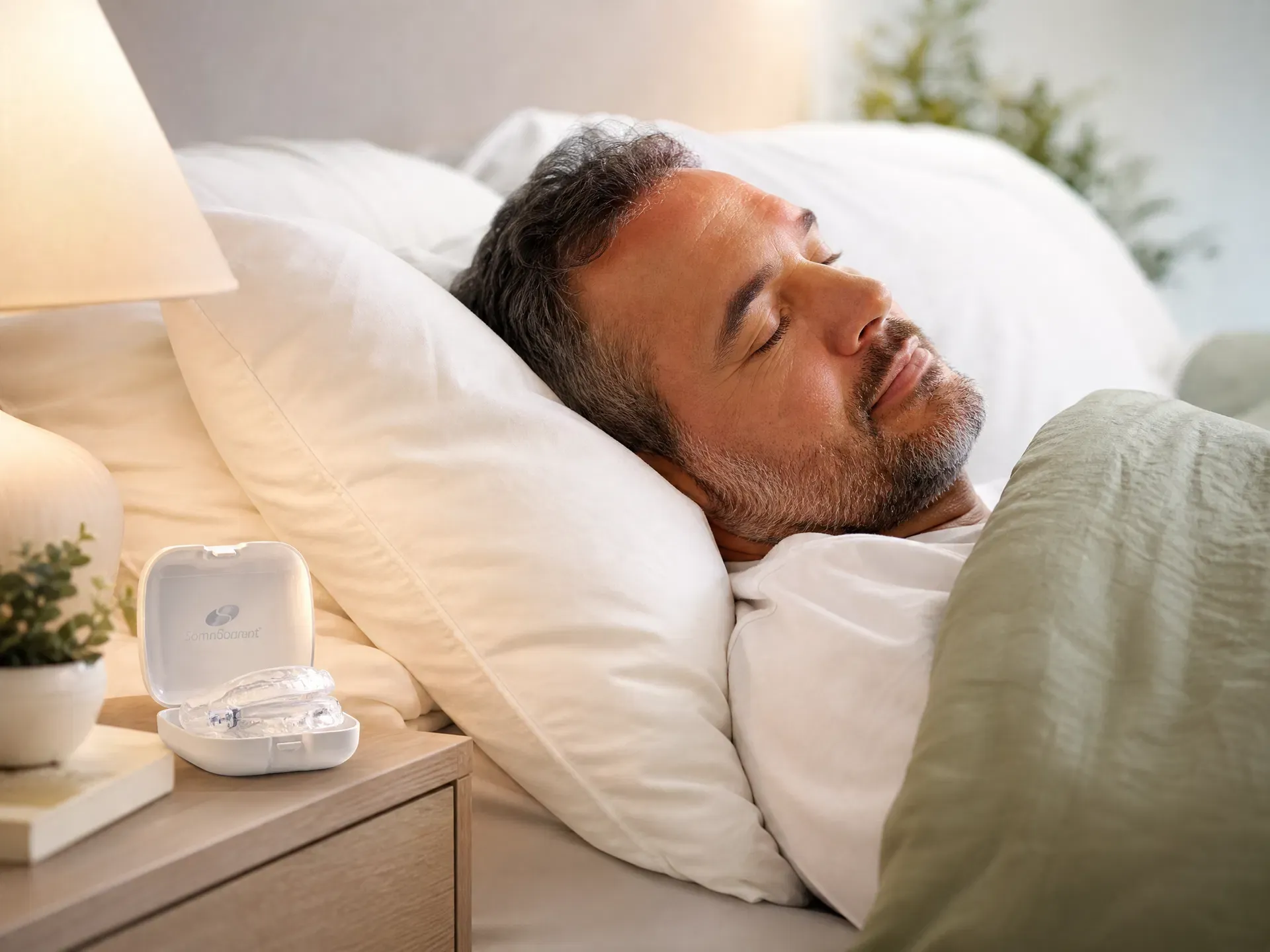
Obstructive sleep apnoea (OSA) is the repeated narrowing or blockage of the airway during sleep, with each event lasting ten seconds or more. It is diagnosed by a sleep physician through a sleep study, never by a dentist, and it is treated in a partnership: for snoring and mild to moderate OSA, a custom-made oral appliance that holds the lower jaw gently forward is an effective, well-tolerated option supported by published clinical guidance. At Sydney Holistic Dental Centre we screen, refer for diagnosis, and fit and manage appliance therapy in co-operation with your sleep physician.
As you fall into deeper sleep, the muscles of the tongue and throat relax. In a vulnerable airway they relax far enough to narrow the passage (a hypopnoea) or close it entirely (an apnoea). Oxygen falls, the brain registers the emergency and briefly rouses you, often without your awareness, the airway reopens with a gasp or snort, and the cycle restarts. In moderate OSA this happens fifteen to thirty times an hour, all night. The result is sleep that never reaches its restorative depths, and a cardiovascular system doing interval training when it should be resting.
Published research associates untreated OSA with high blood pressure, type 2 diabetes, weight gain, low mood, memory problems and a markedly higher accident risk from daytime sleepiness. Partners suffer too, and the bed-partner report ('you stop breathing, then gasp') is one of the most reliable screening signals we hear. None of this is said to alarm; it is said because OSA is common, underdiagnosed and genuinely treatable.

Loud, irregular snoring with pauses, gasps or choking sounds reported by a partner
Waking unrefreshed regardless of hours slept; morning headaches
Daytime sleepiness: nodding off in meetings, in front of television, or worryingly, while driving
Waking at night to go to the bathroom more than once
In the chair: worn and cracked teeth, a scalloped tongue, a crowded airway on examination
High blood pressure that is proving hard to control
OSA severity is measured objectively by a sleep study (the AHI, apnoea-hypopnoea index), interpreted by a sleep physician. That number, and the physician's diagnosis, determine which treatments are appropriate; guessing from symptoms is how the wrong treatment gets sold. If our screening raises concerns, we refer you for a study and act on the results. If you already have results, bring them to your consultation, and we start from there.
A mandibular advancement appliance is a custom-made device, fitted to your teeth, that holds the lower jaw slightly forward during sleep. Because the tongue attaches to the lower jaw, advancing the jaw opens the space behind it. Published guidance supports custom appliances for primary snoring and for mild to moderate OSA, and for patients with severe OSA who cannot tolerate CPAP, as agreed with their physician. CPAP remains the gold standard for severe OSA, and we say so plainly; an appliance that suits your diagnosis and actually gets worn every night is the standard we aim for.
Step 1
Assessment of teeth, gums and jaw joints; an appliance needs sound anchor teeth and a healthy TMJ.
Step 2
Digital impressions and a bite registration that records the therapeutic jaw position.
Step 3
Custom manufacture (we prescribe proven systems such as SomnoMed) and a fitting visit with adjustment.
Step 4
Titration over follow-up visits: the advancement is increased gradually until symptoms settle, comfort holds and your partner confirms the difference.
Step 5
Verification with your physician, including a follow-up study where indicated, and review at your regular visits thereafter.

"The appliance is the easy part. The discipline is the pathway around it: a real diagnosis before we start, a physician in the loop throughout, and objective follow-up after. That is what separates sleep dentistry from selling mouthguards."
DR YIN YIN TEOH — PRINCIPAL DENTIST
Image of
Yin Yin
No, and be wary of anyone who offers to. Dentists screen and treat with appliances under a physician's diagnosis; the sleep study and diagnosis belong to sleep medicine.
For mild to moderate OSA, published outcomes for custom appliances are strong, and adherence is typically higher than CPAP. For severe OSA, CPAP is the gold standard. The right answer is your diagnosis plus your physician's advice.
Long-term appliance wear can produce small bite changes in some patients, which is one reason we review at every visit and use morning repositioning exercises. It is a managed, monitored trade-off, discussed before you start.
Custom appliances are quoted in writing after assessment, and some private funds rebate a portion under major dental.
Yes. Primary snoring without OSA is a legitimate appliance indication in its own right; see our snoring page.
Bring your sleep study results, or let us help you get there. We work with your physician from the first appointment.
Yin Yin
image
Dr Yin Yin Teoh
Principal Dentist — Airway & Sleep, Oral Appliance Therapy
Dr Yin Yin Teoh leads the airway programme at Sydney Holistic Dental Centre, with a focus on sleep-disordered breathing, oral appliance therapy and co-management with sleep physicians.