Level 17, 111 Elizabeth Street, Sydney NSW 2000
Level 17, 111 Elizabeth Street, Sydney NSW 2000
Airway & Sleep · Children's Dentistry
A child who habitually breathes through an open mouth is working against their own development. The tongue drops from the palate, where it normally acts as a natural scaffold for the growing upper jaw, night-time sleep becomes lighter and more restless, and the pattern shows up in daytime behaviour, sometimes convincingly enough to be mistaken for attention problems.
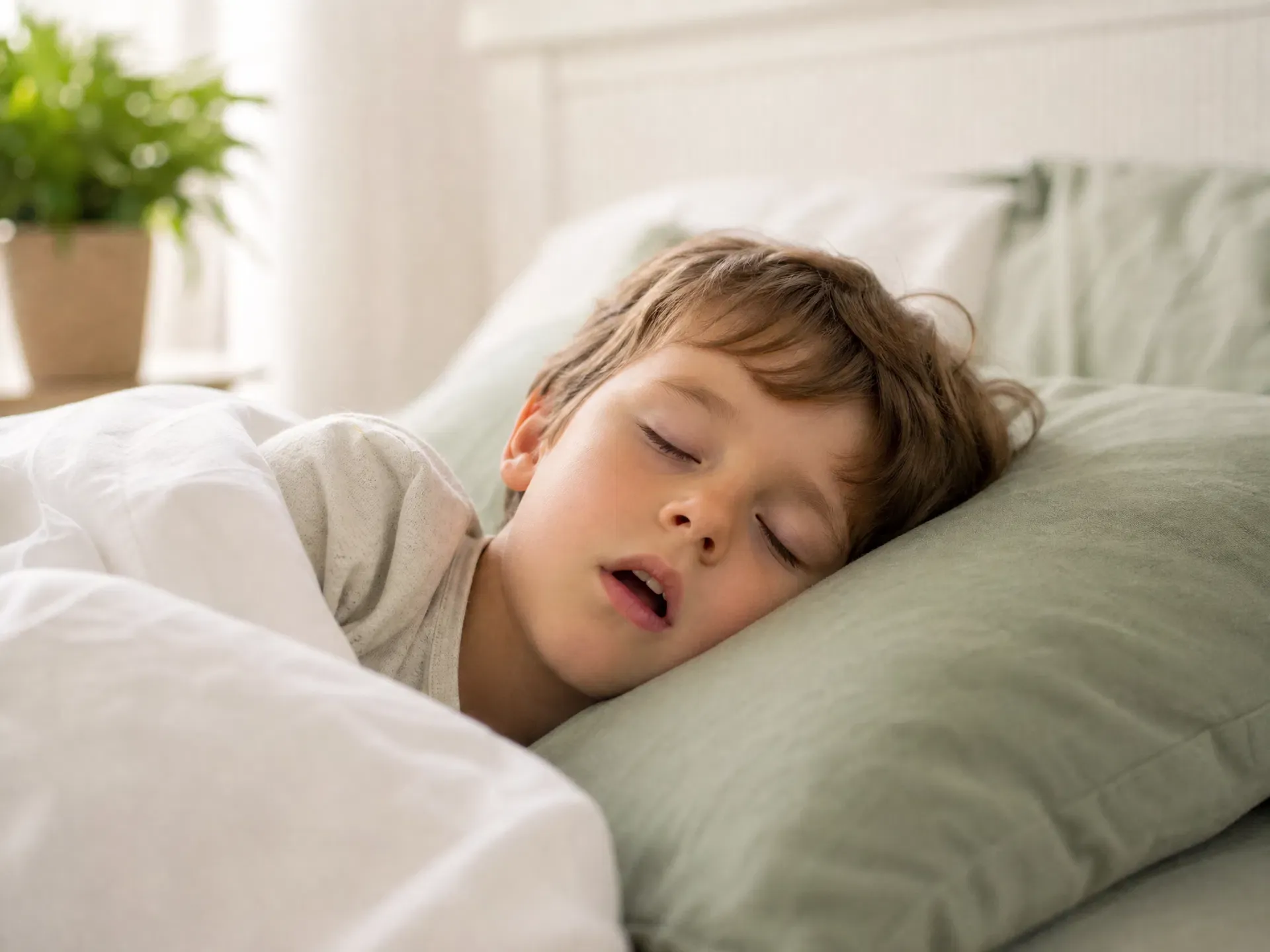
A 2021 systematic review confirmed the association between mouth breathing and altered facial skeletal development in children (Zhao et al., BMC Oral Health). The good news is the flip side: caught early, breathing habits and growth can both be guided, and the earlier the assessment, the more the correction is done by growth itself.

Lips apart at rest: watching television, concentrating, asleep.
Snoring, noisy breathing or restless, sweaty sleep; a wet pillow in the morning.
Waking tired, grumpy mornings, and daytime behaviour or concentration concerns raised at school.
Bed-wetting persisting beyond the usual age.
Dark circles under the eyes; a long, narrow face developing; a persistently blocked nose.
Crowded teeth or a narrow palate flagged at a dental visit, which is often where the whole story surfaces.
Chewing with the mouth open, picky eating with hard textures, or persistent thumb and dummy habits beyond toddlerhood.
The tongue is a powerful muscle, and its resting home is the palate. Resting there, it gently widens the upper jaw from the inside, balancing the inward pressure of the cheeks. When the mouth hangs open, the tongue sits low, the cheek pressure wins, and the palate develops high and narrow, which crowds the erupting teeth and, because the palate is also the floor of the nose, narrows the nasal airway itself. The result can be a self-reinforcing loop: harder nasal breathing, more mouth breathing, narrower growth. Breaking the loop early is the entire point of this page.
Children's sleep quality is built on unobstructed night-time breathing. A child fighting a narrowed airway sleeps lightly, moves constantly, and misses the deep sleep that growth and daytime regulation depend on. Parents are often told these are behavioural issues; sometimes they are simply a tired child. We make no diagnostic claims about attention disorders; we do say that a child's breathing and sleep deserve assessment before their behaviour is labelled, and paediatric research increasingly agrees.
What an assessment involves
Step 1
sleep, snoring, energy, eating, habits, ENT history (adenoids, tonsils, allergies)
Step 2
tongue posture and mobility (including tongue tie), palate width, tonsil size, dental crowding, facial growth pattern, swallowing pattern
Step 3
where the nose itself is blocked: referral to an ENT or allergist, because retraining cannot beat an obstructed airway
Step 4
what to monitor, what to treat now and what growth is likely to do, discussed in plain language
Where the airway is clear and the habit is the problem, treatment pairs breathing retraining with myofunctional therapy: structured daily exercises that restore nasal breathing, lip seal and correct tongue posture, supported in many cases by a Myobrace appliance that trains position while the child sleeps and during a short daily wear window. The approach treats the cause of crowding rather than waiting to straighten its consequences, and in the right cases it reduces the scale of orthodontics needed later.

Details are on the Myofunctional Therapy page.

"Parents bring us crooked teeth and we often find a tired child behind them. Guiding a six-year-old's breathing and growth is quieter work than braces at fourteen, and it is some of the most valuable dentistry we do."
DR YIN YIN TEOH — PRINCIPAL DENTIST
Image of
Yin Yin
From around age three as part of normal dental visits, and promptly at any age when the signs above appear. Early never hurts; the assessment is gentle and mostly observational.
Some do; many simply grow with it, and the facial development consequences accumulate meanwhile. Assessment tells you which child you have rather than leaving it to hope.
Sometimes enlarged adenoids or tonsils are the true obstruction, and that call belongs to an ENT, to whom we refer. Habit retraining follows once the airway is genuinely clear.
It is before braces, and sometimes instead. Myofunctional treatment addresses causes during growth; some children still need orthodontics later, usually less of it. We frame it as prevention with a strong rationale, never a guarantee.
The mouth-breathing and facial-development association is supported by systematic review evidence (Zhao et al., 2021), and airway-focused paediatric dentistry is an active, growing field. Where evidence is still developing, we say so at the consultation.
The right time to assess is before the window closes. Book a children's airway assessment at SHDC.
Yin Yin
image
Dr Yin Yin Teoh
Principal Dentist — Airway & Sleep, Children's Dentistry
Dr Yin Yin Teoh leads the airway and children's dentistry programme at Sydney Holistic Dental Centre, with a focus on early intervention, myofunctional therapy and airway-guided growth.